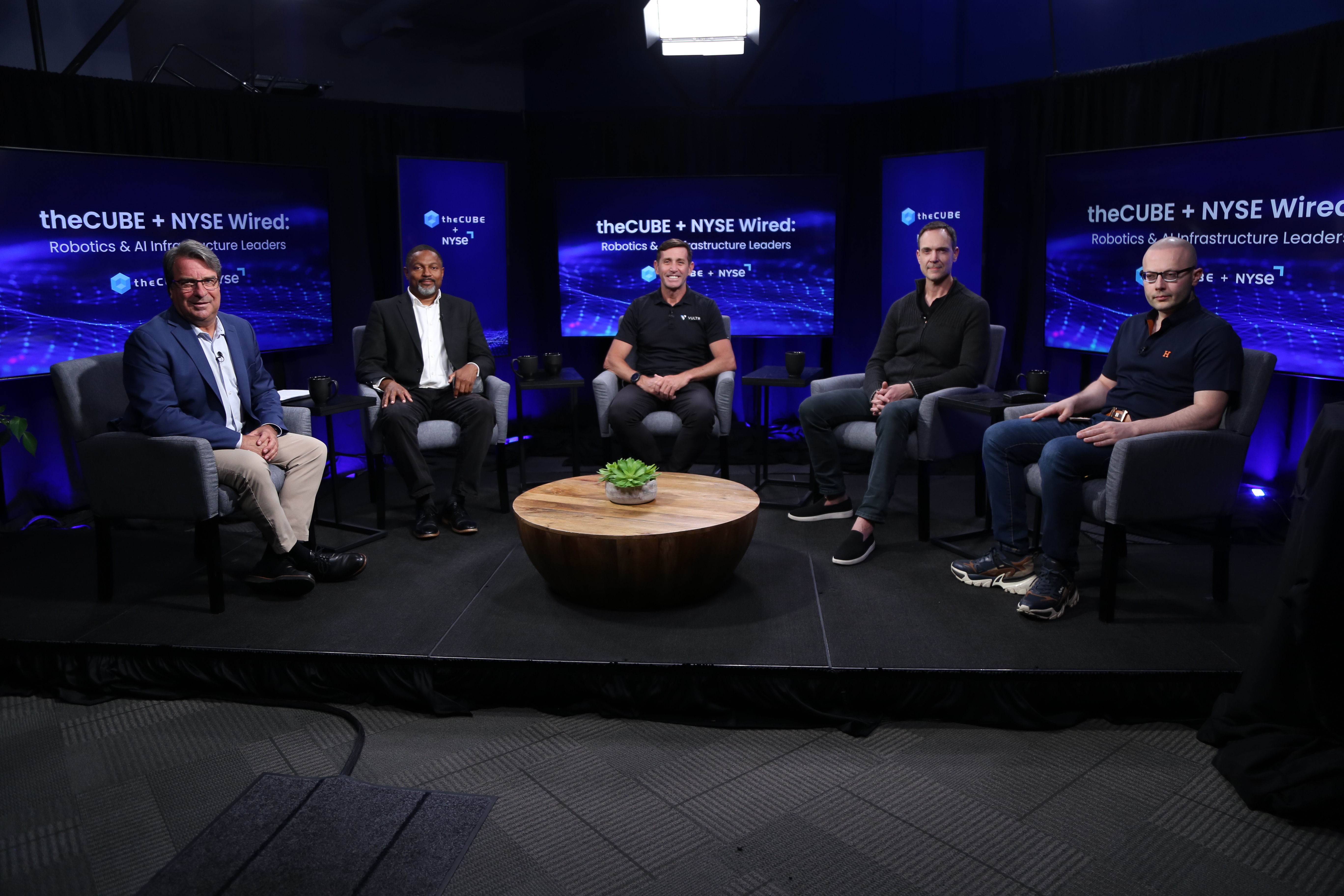
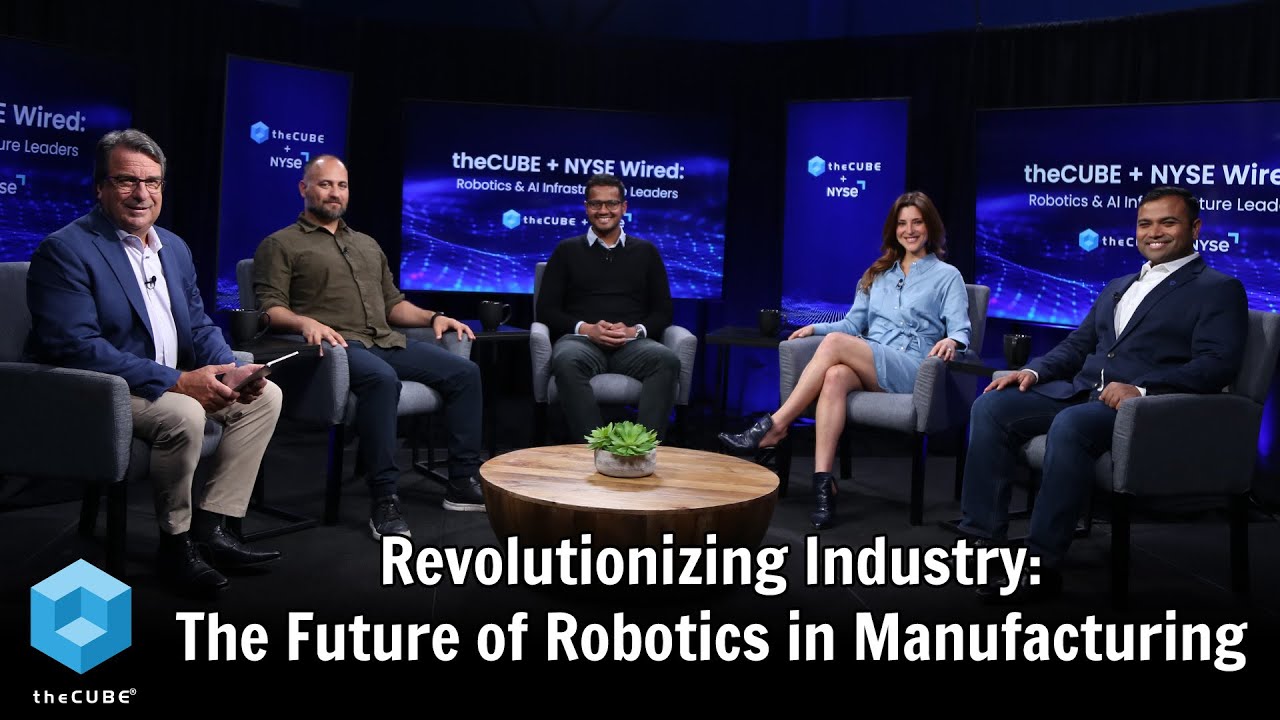
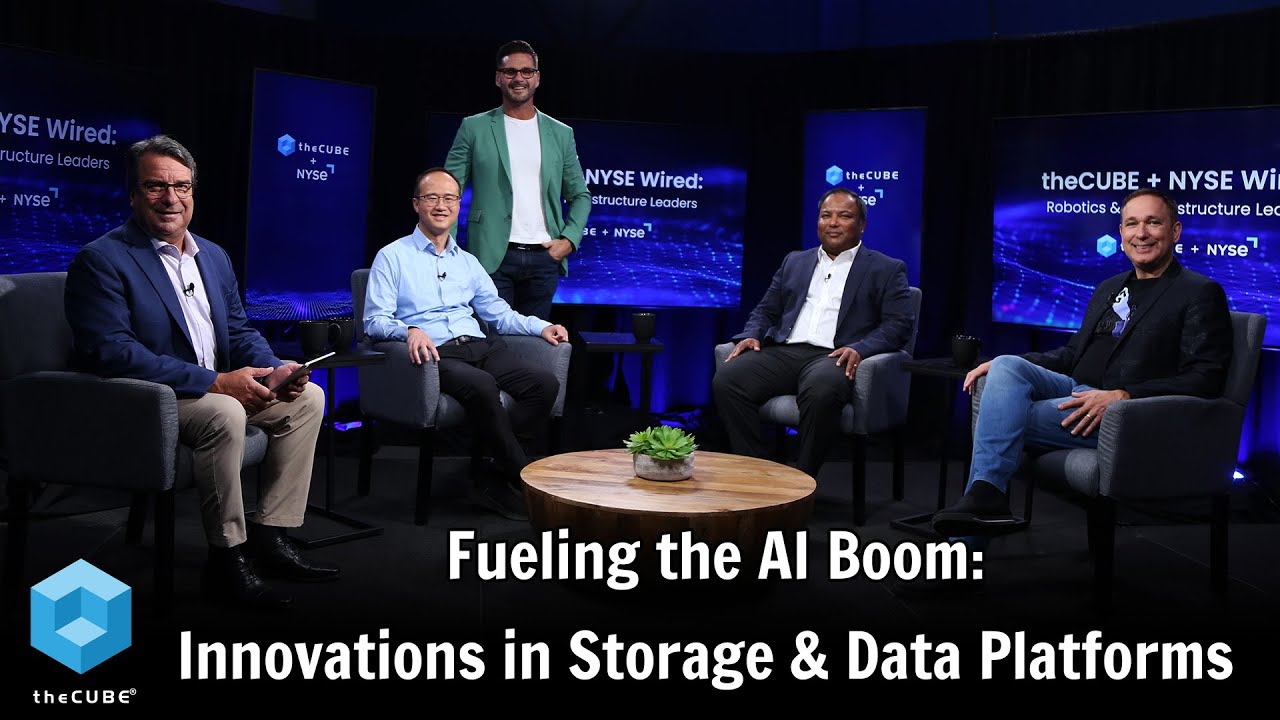
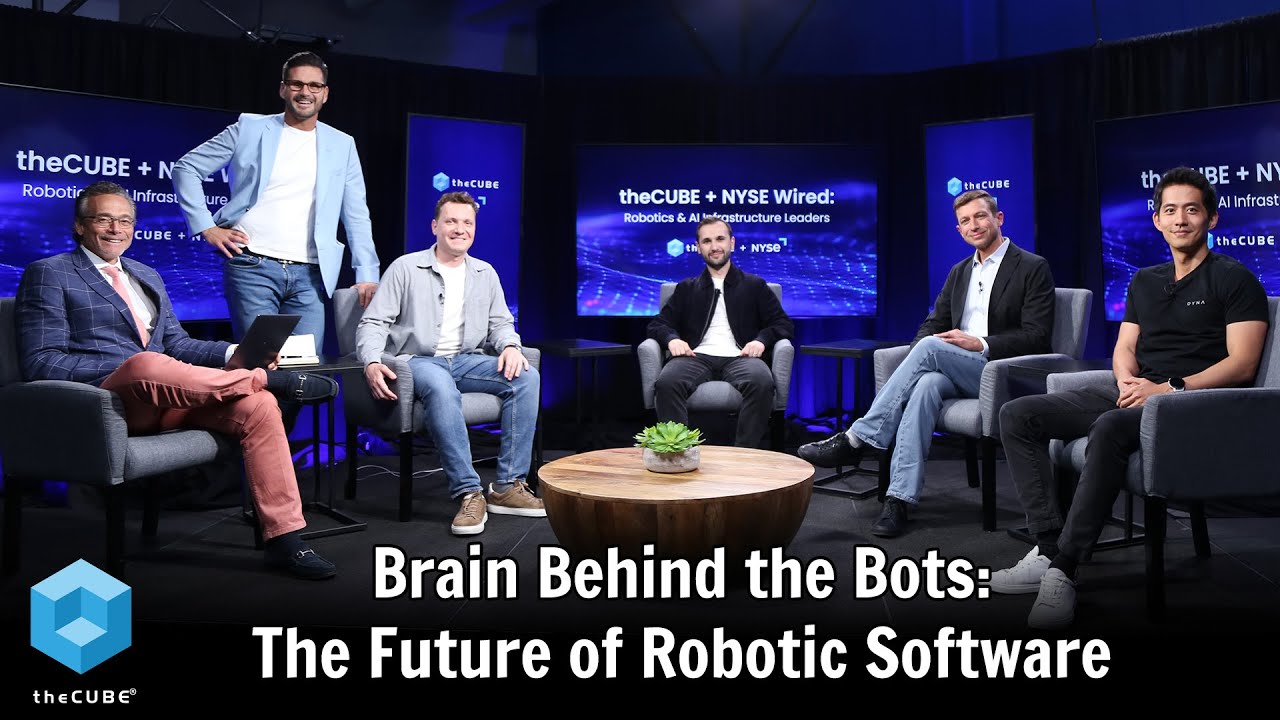
Andy Hock, senior vice president of product & strategy at Cerebras Systems Inc.; Shehram Jamal, chief product officer for data & models at HUMAIN (Al-Mustaqbal Lil-Thaka Al-Istinai Company, also known as Future Artificial Intelligence Company); Kevin Cochrane, chief marketing officer at Vultr, a registered trademark of The Constant Company LLC.; and Joseph S. Spence, chairman, chief investment officer at NativelyAI, join theCUBE’s John Furrier at theCUBE + NYSE Wired: Robotics & AI Infrastructure Leaders 2025 event. The panel explores how robotics and AI infrastructure are reshaping global innovation and sovereignty in the AI era.
The panelists examine regional approaches to AI deployment, emphasizing sovereign strategies and compute accessibility across economic divides. They discuss the cultural and geographic nuances shaping infrastructure choices and development priorities.
From scaling compute capacity to redefining AI as a public good, the conversation highlights the sector’s high stakes and even higher potential. The discussion offers a grounded take on building equitable, globally competitive AI ecosystems.
Forgot Password
Almost there!
We just sent you a verification email. Please verify your account to gain access to
theCUBE + NYSE Wired: Robotics & AI Infrastructure Leaders. If you don’t think you received an email check your
spam folder.
Sign in to theCUBE + NYSE Wired: Robotics & AI Infrastructure Leaders.
In order to sign in, enter the email address you used to registered for the event. Once completed, you will receive an email with a verification link. Open this link to automatically sign into the site.
Register For theCUBE + NYSE Wired: Robotics & AI Infrastructure Leaders
Please fill out the information below. You will recieve an email with a verification link confirming your registration. Click the link to automatically sign into the site.
You’re almost there!
We just sent you a verification email. Please click the verification button in the email. Once your email address is verified, you will have full access to all event content for theCUBE + NYSE Wired: Robotics & AI Infrastructure Leaders.
I want my badge and interests to be visible to all attendees.
Checking this box will display your presense on the attendees list, view your profile and allow other attendees to contact you via 1-1 chat. Read the Privacy Policy. At any time, you can choose to disable this preference.
Select your Interests!
add
Upload your photo
Uploading..
OR
Connect via Twitter
Connect via Linkedin
EDIT PASSWORD
Share
Forgot Password
Almost there!
We just sent you a verification email. Please verify your account to gain access to
theCUBE + NYSE Wired: Robotics & AI Infrastructure Leaders. If you don’t think you received an email check your
spam folder.
Sign in to theCUBE + NYSE Wired: Robotics & AI Infrastructure Leaders.
In order to sign in, enter the email address you used to registered for the event. Once completed, you will receive an email with a verification link. Open this link to automatically sign into the site.
Sign in to gain access to theCUBE + NYSE Wired: Robotics & AI Infrastructure Leaders
Please sign in with LinkedIn to continue to theCUBE + NYSE Wired: Robotics & AI Infrastructure Leaders. Signing in with LinkedIn ensures a professional environment.
Are you sure you want to remove access rights for this user?
Details
Manage Access
email address
Community Invitation
Axel Lönnfors, Metabob
In a revealing panel discussion, industry leaders gather at theCUBE’s Palo Alto studios to explore the transformative world of robotics and AI infrastructure. This session, part of the NYSE Wired event, offers rich insights into current trends, challenges and future prospects of AI infrastructure on a global scale.
Featured experts include Shehram Jamal of NVIDIA, Kevin Cochrane of Vultr, Joseph S. Spence of NativelyAI, and Andy Hock of Cerebras Systems. John Furrier of SiliconANGLE Media moderates the discussion, which delves into the interplay between global infrastructure upgrades and the burgeoning robotics and AI sector.
Panelists explore the phased approach in deploying AI infrastructure, highlighting significant shifts and emerging trends. The dialogue covers the cultural and geographical implications as AI technologies permeate diverse markets and the role of sovereign AI strategies. As noted by the panelists, countries worldwide race to develop AI capabilities to remain competitive, focusing on integrating culture-specific innovations and expanding their talent pool.
Jamal and Hock emphasize the crucial need for substantial advancements in AI compute capabilities and collaborative innovation to fuel growth. Cochrane highlights the importance of broadening access to AI infrastructure to foster innovation globally. Spence addresses the strategic significance of AI as a public good and its potential to reshape economic landscapes. As AI technologies continue to evolve, their potential to proactively address economic, social and technological challenges cannot be overstated.
>> Hi, everybody, welcome back to the Rosewood. This is Dave Vellante in for John Furrier and the whole theCUBE team, theCUBE + NYSE Wired. This is an extension of our AI robotics leaders, our media week that we've been running out of Palo Alto with the NYSE Wired + theCUBE community. We've taken it poolside to the Rosewood here and I'm really excited to have Axel Lönnfors, who's the COO of Metabob. I don't know if you've heard of Metabob. Welcome.>> Thank you. Thank you.>> What's Metabob?>> So we're an AI code analysis tool that connects graph neural networks to large language models, to essentially enable large language models to take in a full legacy code base written in any of the old languages that you would name from COBOL, VB.NET to the modern ones like Python. And along the way, with C and C++, you can dump your whole code base with millions of lines of code. And without losing any context or hallucinating with LLM, our graph neural network is essentially able to detect problematic areas in the code, as well as areas for improvement in optimization and refactoring along your code base. And helping organizations to cut their technical debt by a lot.>> So using that GNN to automate the modernization of that code, which used to be a highly manual process.>> Yes.>> And one that was problematic because let's say you're trying to migrate from COBOL, you would have to freeze the code, and it might have to freeze it for a long time. Meanwhile, your business is trying to run, and so what's the enabler that allows you to do that? Obviously AI, but give us some color on that piece.>> Right. So we don't yet focus on migrating code from a language to another, even though theoretically with our technology, it is also possible. What we want to focus on is using our proprietary analysis model to flag problematic areas from basically a bird's eye view on the graph of the code. Because the graph represents how different code chunks connect to each other along the code base.>> Okay, I see.>> And we then can do an anomaly detection of problematic areas. We can narrow down the relevant context space. And then pass that information to a fine-tuned large language model that can be used to generate a more detailed description of the problem, as well as to generate the fix for the detected problem.>> So just to put a finer point on it, you are converting the code ultimately, are you not? Or are you just sort of identifying the anomalies? Is it both?>> We are identifying the anomalies and we are fixing the anomalies.>> Yeah, okay.>> So we do generate code.>> Okay, but you'll fix them in COBOL or whatever language is needed to run?>> Yes, we can analyze COBOL and fix them in COBOL.>> Interesting, okay. Because there are a lot of tools that will convert the code, that's not what you're doing.>> That's not what we're doing.>> Your superpower is identifying those anomalies and fixing them in an automated way.>> Correct, that's what our business currently is. Our clients, they range from government agencies to Fortune 500 companies, so we really went headfirst into the enterprise space as a young startup. And currently, when everyone is talking about agentic AI, we're also able to act like as a control tower. So let's say that you use an agentic AI, you use it to build a larger application. It runs into a problem because it's starting to lose the context and the intent of the application and introducing some 502 errors when you're trying to deploy it. Essentially, when that happens, we can integrate into the agentic flow that when it runs into a problem, it automatically calls an analysis from our back end. We analyze the whole repository, we come up with a list of problems. And then we match the right problem to the problem that the agentic AI is currently experiencing, helping it to overcome that problem.>> And you sell to the head of application development or developers? Who do you sell to?>> Yeah. We sell depending on how large of an organization we're working with, but it would range from head of software engineering, to VP of software engineering all the way to CTO, depending on the size of the company.>> Okay. And you guys, have you funded, are you seed round?>> Yeah. So we have raised our first round a few years ago, after which we have already become profitable for a while, as well as got funded by the National Science Foundation of the United States. And now we're just gearing up to raise a little bit more money to also work on newer integrations into the more modern space of agentic AI, while continuing to serve our customers and expanding the legacy code base analysis side.>> Do you feel like you have product market fit?>> We're close to product market fit. We have great customers. The feedback is good. To have product market fit, I would always, I'm a critical person, I want to have hundreds of customers in->> More maturity, okay.>> More maturity. But for a young company, we're on a good way.>> So you're not scaling your go-to-market quite yet, is that right?>> We're trying to scale in specific verticals, including finance, manufacturing and government.>> Government, yeah.>> But also looking to do POCs in new verticals, such as healthcare, gaming, et cetera, for our tool.>> What's the North Star of the company? How would you describe that?>> North Star is customer satisfaction with the tool, that's the only thing we care about. How much value can we provide? How much time can we save from maintaining their legacy code bases? That's what we want to provide for our customers.>> Yeah, because nobody wants to do that.>> Yeah, everyone wants to do that.>> Axel, thanks so much for coming to theCUBE.>> Thank you.>> We appreciate it.>> I appreciate it.>> All right, and thank you for watching. Keep it right there for more action from the Rosewood, you're watching theCUBE + NYSE Wired Media Week, AI and Robotic Leaders. We'll be right back, right after this short break.