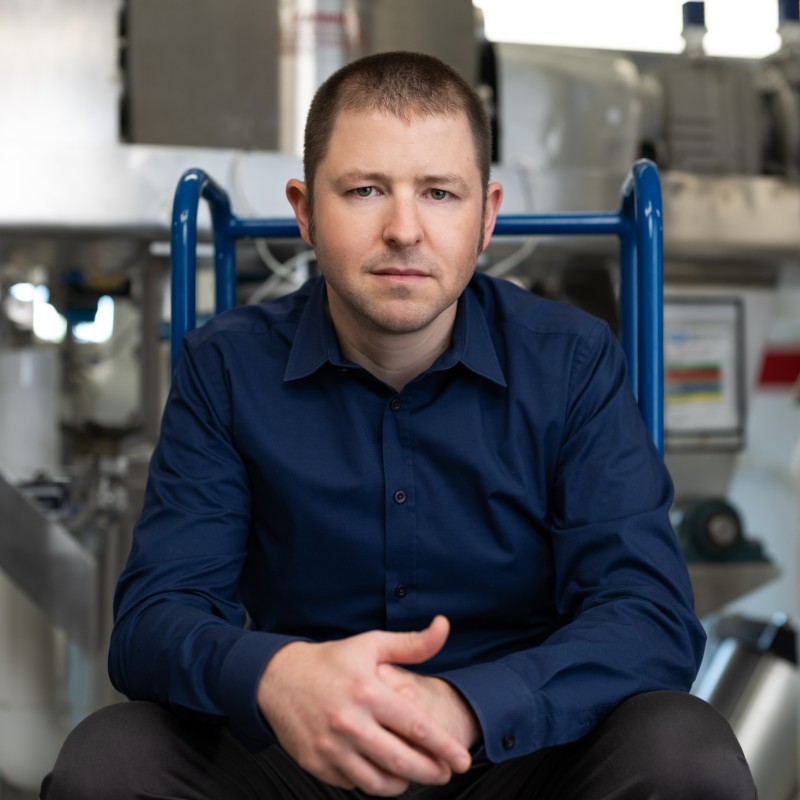
Saar Yoskovitz, CEO and founder of Augury, discusses how their company helps manufacturing companies improve reliability, productivity, and sustainability using AI. They monitor machines using sensors to detect malfunctions in real time, helping companies avoid downtime and increase revenue. Saar emphasizes the importance of data collection, integration, and domain expertise in successfully implementing AI solutions in manufacturing.
The conversation also touches on the shift to generative AI, the significance of trust in AI systems, and the potential of digital twins in manufacturing. Saar highlights the need for simulation tools and real-time analytics to drive impactful outcomes in production processes. Augury's vision is to become a partner for their customers, addressing all their AI and digital needs in the manufacturing space.
Overall, the discussion showcases how AI is transforming the industrial sector and the challenges and opportunities that come with integrating advanced technologies in traditional manufacturing processes.
Forgot Password
Almost there!
We just sent you a verification email. Please verify your account to gain access to
theCUBE + NYSE Wired: Worldwide. If you don’t think you received an email check your
spam folder.
In order to sign in, enter the email address you used to registered for the event. Once completed, you will receive an email with a verification link. Open this link to automatically sign into the site.
Register For theCUBE + NYSE Wired: Worldwide
Please fill out the information below. You will recieve an email with a verification link confirming your registration. Click the link to automatically sign into the site.
You’re almost there!
We just sent you a verification email. Please click the verification button in the email. Once your email address is verified, you will have full access to all event content for theCUBE + NYSE Wired: Worldwide.
I want my badge and interests to be visible to all attendees.
Checking this box will display your presense on the attendees list, view your profile and allow other attendees to contact you via 1-1 chat. Read the Privacy Policy. At any time, you can choose to disable this preference.
Select your Interests!
add
Upload your photo
Uploading..
OR
Connect via Twitter
Connect via Linkedin
EDIT PASSWORD
Share
Forgot Password
Almost there!
We just sent you a verification email. Please verify your account to gain access to
theCUBE + NYSE Wired: Worldwide. If you don’t think you received an email check your
spam folder.
In order to sign in, enter the email address you used to registered for the event. Once completed, you will receive an email with a verification link. Open this link to automatically sign into the site.
Sign in to gain access to theCUBE + NYSE Wired: Worldwide
Please sign in with LinkedIn to continue to theCUBE + NYSE Wired: Worldwide. Signing in with LinkedIn ensures a professional environment.
Are you sure you want to remove access rights for this user?
Details
Manage Access
email address
Community Invitation
Saar Yoskovitz, Augury
Saar Yoskovitz, CEO and founder of Augury, discusses how their company helps manufacturing companies improve reliability, productivity, and sustainability using AI. They monitor machines using sensors to detect malfunctions in real time, helping companies avoid downtime and increase revenue. Saar emphasizes the importance of data collection, integration, and domain expertise in successfully implementing AI solutions in manufacturing.
The conversation also touches on the shift to generative AI, the significance of trust in AI systems, and the potential of digital twins in manufacturing. Saar highlights the need for simulation tools and real-time analytics to drive impactful outcomes in production processes. Augury's vision is to become a partner for their customers, addressing all their AI and digital needs in the manufacturing space.
Overall, the discussion showcases how AI is transforming the industrial sector and the challenges and opportunities that come with integrating advanced technologies in traditional manufacturing processes.
Saar Yoskovitz, CEO and founder of Augury, discusses how their company helps manufacturing companies improve reliability, productivity, and sustainability using AI. They monitor machines using sensors to detect malfunctions in real time, helping companies avoid downtime and increase revenue. Saar emphasizes the importance of data collection, integration, and domain expertise in successfully implementing AI solutions in manufacturing.
The conversation also touches on the shift to generative AI, the significance of trust in AI systems, and the potentia...Read more
>> Hello, welcome back to theCUBE. Here, the NYSC, theCUBE and the NYSC Wired Connection with theCUBE and Brian Baum and the NYSC team is here bringing you another media week. I'm John Furrier, host of theCUBE, our East coast location, and we got a great guest here. Saar Yoskovitz is the CEO, founder of Augury, doing very, very well. Entrepreneur in the action. Great to have you on here. We'll try to get your logo up on the big cubes, they call them, which is not related to our cube, but it's their cubes. Great to have you on here, on our cube.>> Thanks for having me. We'll get this done next time. Don't worry.>> We'll get that next time. All right, so let's get into the company that you founded. I want to get into some of the work you're doing because you are applying AI to a real, what I call meat and potatoes, use case, real business. You guys deal with a lot of manufacturing, a lot of companies involved that just run brick and water type businesses. Give a quick overview of what you guys do.>> Augury, we work with the largest manufacturing companies to help them make their production lines more reliable, more productive, more sustainable. As an example, today, 20% of Fortune 700 companies are Augury customers. The top food and beverage, pharma, CPG, chemicals, et cetera. And we work with their executives to see how we can infuse AI into every layer of the manufacturing stack. I would say, at the most basic level, we listen to machines and based on the noise we can tell you what's wrong with them. We have a full set solution. We actually have our own hardware sensor that we physically install on a machine.>> Can I see?>> We measure certain aspects like vibration and temperature, magnetic emissions of the machine to tell you in real time if you have any malfunctions developing so you can stop them before they happen. And as a result, I'll give an example from one of the largest food companies where last year we helped them avoid 4,000 hours of downtime, which equaled 10 million pounds of food product that we're able to manufacture, like snacks. And to them, this is a->> Huge cost savings right there.>> And also top line revenue increase because every potato chip they manufacture, they know how to sell. How do we leverage AI to have clear business impacts on our customers?>> Saar, instrumentation provides a lot of data. Instruments do data, obviously they're throwing off a lot of data. It's a great IoT like example. How do you guys make sense of that? Do you ingest the data? Take us through some of the working mechanisms. You got a sensor, you connect to the devices, what happens next?>> Today, we take data from two different sources. We have our own sensing platform, our own hardware, and we also can ingest data from the existing systems that are on the production line. It's called the manufacturing execution system or the historian. And then, we can couple the mechanical data, how is the machine behaving with the operational data of what am I telling the machine to do? How am I operating the machine? And this way we can increase not just the uptime of the machine, avoiding malfunctions, but also reduce waste, reduce energy consumption, improve yield and throughput. A lot to say here, but for our own hardware, to me, we'll talk about AI quite a bit today. AI is only as good as the data set that it's trained on, our model is. And we basically standardize our own data set through our own hardware, and what that means, today we have over half a billion hours of machines that we've monitored and we can use and leverage that data in order to continuously improve our algorithms, create new types of insights, increase coverage, et cetera.>> We love when they hear the noise on the floor, it means a big trade is going down. It brings back the old NYSC. Whenever I hear people yelling, I love it, "Yeah, big trade." Someone made some money, cha-ching. Let's talk about when you guys were founded. Share how long ago did you start the company? How many years ago? When was it formed?>> We started 13 years ago, two co-founders, myself and my partner. We actually met at the university and both of us are engineers, and I focused on speech recognition in my studies. And when you think about it, the problem that we solve is very similar. You listen to a machine, you take an audio wave, and you try to find meaning inside of it. But instead of searching for words, you search for malfunctions. That's how we started, and we also have affinity to machines in the industrial space. Started talking to factories, to commercial buildings, OEMs of these machines, to understand what is the best path to market, and we've been at it for over a decade now.>> It's interesting because you have seen that first wave of machine learning, supervised, unsupervised machine learning, predictive analytics. GenAI is a new category. It doesn't go away. The old categories of predictive and machine learning ride into generative AI. Talk about that dynamic when you had that GenAI moment, when was it that you said, "Hey, things are generated," which is not a programmable thing. That's something that's making use of the data. Talk about that experience and what that's done for your business.>> I think, first of all, I fully agree. We started with statistical models and neural networks, deep learning. Now we have conformers and large language models, et cetera. At the end of the day, from a customer perspective, what we understand is AI is a tool, it's not an outcome. Let's focus on what is the business outcome that you want to drive and then what is the right tool set in order to achieve it? What we're seeing specifically in the industrial market is that there is no room for mistakes. I tell the team, "At the end of the day, we don't sell sensors and we don't sell AI, we sell trust." And if our customers want to see the behavioral change, the cultural change and impact, if the maintenance technician or the operator doesn't trust the system, they go back to their old habits. Now you start introducing hallucination into the process, there's a certain element of->> Which does not foster trust, by the way.>> Exactly. So moving from generative AI to reliable AI, I don't care what technology you use, I just want it to be reliable. There is definitely room for generative in our world, less maybe on the diagnostic side, more on the user interface. We're seeing more natural conversation. I want to be able to ask a question and then get all the data to support that answer. We do have generative AI components in our platform as well as internally. I would say that there's a lot of benefits we've already seen.>> Saar, when you're talking, it just floods my brain with all this IoT consciousness that we've had over the past decade, industrial IoT, whether it's manufacturing critical infrastructure, now add in security because we do a lot of conversations with security pros on either threat hunting, threat detection, just for recovery and resilience, being resilient. So this idea of trust is huge and this idea of it can't fail is a critical system. Critical systems need trust, good automation and delegation. You got to have good governance. And so, these are business concepts applied now to technology. The interesting thing is the neural network format is not, it's a format where machines take over and that's where the scale comes in. Talk about how you're starting to see that permeate into your customers. Because I was having a conversation with a security pro who's an AI engineer and he was very pragmatic because security people are very pragmatic. I'm sure your customers are too. He said, "Generative AI, it's just another application," and he's not wrong actually.>> Yeah, it's true.>> Gen, it's just another thing. It's got to go through AppSec review, goes through these processes. So trusting in this governance piece of, "Okay, it's vetted, now I got to put it into production." These are the same concepts that were pre-GenAI.>> Correct.>> What's different now with this new GenAI. What are some of those constraints? What are the challenges and opportunities with generative AI that's different, that will have an impact to the customer environment?>> First of all, I fully agree with your assessment, and I mentioned we're kind of infusing AI into every layer of the stack and we mean it. By that I mean that this is a new sensor we just launched a couple of months ago, it's the industry's first sensor that is capable of running Edge AI, running neural networks on the Edge. And then, the whole network architecture is also infused by AI and self-healing networks because reliability of the network, the safety and security of the network, is as important as a result. To your question, in our conversations with executives and senior executives in manufacturing, what they've noticed is that the tools that they used to have in the toolbox are no longer available, meaning they can't just offshore to China anymore because of geopolitical issues. They can->> And supply chain risks.>> Supply chain risks. And they can't hire more people because they can't find more skilled talent. They can't raise prices because of the economy, and now we have sustainability pressure from regulators or the consumers. So they fundamentally need to think differently about how they run a production mine or a factory. We had an industry survey recently and we saw that 83% of leaders have increased their AI budget and spending compared to last year. How are things changing? I think there's an openness to reimagining the org structure, the different roles on a production line, the processes and procedures, and infusing again technology into the day-to-day of the frontline workers to increase their productivity.>> Tech is not a service entity for the business. It is the business.>> It has to be.>> It's interesting because the mindset shift culturally hits both sides of the ledger, cost and revenue, because you get cost efficiencies from productivity and also hard cost gains as well as enabling the app to be a better service vehicle for revenue generating.>> And you get agility.>> Agility.>> And agility is very crucial, especially with all these surprises around supply chain .>> Give an example of agility for customers you've worked with or how GenAI could render itself as an agility value proposition.>> As an example, I have a ton of them, but just one example, we look at machine health, which is a mechanical machine and look at process health. How are you running the machines? Today, if I'm a manufacturer, and due to the economy, I need to shut down a factory and I need to move production from here over there, how quickly can I do that? How quickly can I train this team, which maybe have never manufactured this product line, on a new product? If I've already digitized the knowledge, I digitize the operational envelope, if I can shorten the turnaround time between product A and product B, I gain this flexibility of turning on and off production lines. If we look at a more macro view, and you have a very technical kind of audience to me, one of the most maybe ironic outcomes over the last few decades is that all the goodness we've seen in product R&D around agile and around we call it future squads or cross-functional and power teams, all came from manufacturing. It all came from the Toyota production system, and then lean manufacturing and lean thinking. But in order to do so, in order to bring product and R&D closer, or sales and marketing closer, we had to invent a trillion dollar industry called DevOps or RevOps. But the industrial market never went through that same change in how the teams are structured, and now it's an opportunity to leverage the same tools or similar tools to bring them back to the originating industry so they can also get the same benefits.>> It's a Renaissance for manufacturing, really is.>> Yes.>> I mean, the Agentic app is going to be very helpful. I want to get your thoughts on agents and what's coming around the corner, assuming things are shifting in the platform, the mindset's shifting. Domain expertise is huge.>> Correct.>> A big part of what we're seeing in the enterprise. The industrial edge, even more compelling to have domain expertise because you have distributed computing understanding and end-to-end workflows around data. You can't just throw AI at that. You can't just say train my enterprise because the domain experts involved have to know the process.>> Correct.>> So you have to do process mining and understand the nuances of the knobs and switches that have to get turned, a metaphor oversimplified, but there are specific things that are unique to every workflow.>> Correct. Yeah, 100%.>> The importance of domain expertise in this horizontally scalable data layer with the vertical specialization around the domain.>> First of all, we pride ourselves in having on our team, we have the AI data scientists and algorithm developers as well as field technician and solution architects and reliability experts and process engineers because you can't have one without the other to really be successful. When you look at the domain expertise, it goes from how do I know which data to collect? Two years ago, when I started collecting data, which data to start collecting and can I leverage it today? And then, when you train the models, data is only good if it's also tagged correctly and verified. So how do I infuse the domain experts when I train the data and also post-implementation? Every once in a while, I do need that expert verification because we cannot be wrong. We can't give the wrong recommendation. So how do we throughout the, call it customer journey and product development journey, we have these domain experts sitting in the same room with the technology R&D engineers.>> Take me through the integration because when you instrument a line, you got to integrate and so you got to connect back office with front office, there's cost revenue, so there's an integration play here. What's your reaction to that? How would you talk about integrating your system to be fully capable of unlocking that value from the data?>> One of the biggest challenges in the industry today is we talk about data lakes, but in reality we have data swamps or data tar pits depending how grim you want to be.>> Get sucked into the tar pit. Bunch of dinosaurs in there, fossils. IT fossils.>> Exactly. That is a huge challenge because every factory, even if they use the same machines by the same OEMs, they had a different system integrator that customized it, et cetera. Our first approach for what we call machine health has been to just create our own data set. We don't need to integrate into anything. We come in, we superglue a sensor on your machine, a few sensors on your machine, connect it to the cloud and we basically bypass all of the legacy systems, working with IT, working with security, but bypass all of the legacy systems and create that direct connection. The time to value could be->> So agility kicks in, your speed.>> Time to value could be as quick as one day. We had a customer where, this year, we deployed on April 24th. On April 25th, we found a malfunction, their technicians fixed it, and they had 1.5X ROI for the full annual program just by the speed of which we work.>> That's an easy sell. Cut the line when suppliers are standing there and saying, "We have AI," right?>> Exactly. Just focus on business impact, not on the tools.>> Saar, really great conversation. My final question I want to ask you is digital twins have been hot in manufacturing because you can create a twin, look at process improvement, efficiency, do simulations, all great, but now the term's broader now because you can move beyond manufacturing and put a digital twin for any process. The concept, it's not a direct one-to-one correlation because manufacturing's different than say marketing department or sales or whatever function. TheCUBE research believes and we believe that digital twins will emerge now with Generative AI because you can do the simulations.>> Exactly.>> You can do some efficiency identification with AI, then bring it in versus deploying it in and then going, "What happened?" You can do both, but people are leaning to getting use cases, understand what's possible, and then go immediately to a digital twin to get data to figure out what data's the best.>> Correct.>> Iterate on that in the twin environment, and then move it in as a first-class citizen. What's your thoughts?>> Exactly. First of all, I typically try to shy away from vague terms, and we saw it with IoT in the beginning, then AI. Digital twins are, to me, you ask five different people what they mean and get 10 different answers.>> Yeah, exactly.>> I think the key word you said is simulation. If I have the ability to build a simulator based on a specific subsystem or sub-process that I know which is similar between industries, between companies, and then I take your specific historical data, I run it on the simulator, and now I can predict in real time the changes you want to make on the line or the process. To me, that is a digital twin. The ability to leverage technologies like reinforcement learning or maybe transformers as well to build that simulator. That is going to change everything. That's what we're doing on the process health side as we->> Outcome driven too. I mean, the ultimate test is does the outcome get changed? Because that's the goal.>> And one analogy we look at in our industry is it's very similar to driving navigation in cars. We all used to have maps, paper maps, and then before you go on a trip, you paint the route you want to go and if you make a mistake and take a wrong turn, then good luck trying to figure it out while you're driving. And then, we have the first generation of GPS devices that could help you go from point A to point B, but they didn't know if there was a traffic jam or a road closure or an accident. And only when we got Waze or Google Maps or Apple Maps, now we have this real-time turn-by-turn navigation that is aware of what's happening around you. That's where we need to bring the industry to. If the humidity in the room change and I'm baking bread, it's going to have huge impact on the quality of the product. I want to be aware of that and change the temperature of the oven in real time. I need that simulator. I need that real-time turn-by-turn navigation.>> Saar, great conversation. Love the data swamp, data tar pit. I'm going to use that. I'll reference you. I'll give you credit for that one, it's a good one because I can throw the word dinosaur in there because a lot of dinosaurs in IT. But what's next for you guys as you embark on the new Edge devices that are going to grab data? I'm sure they're going to get smaller faster. They're going to have soon processors on them, multi-threaded capabilities to co-locate data. You're sending data, you're receiving data. You're instrumenting things intelligently. What's next for you guys and the company? What's that next hill you're going to climb? What's the vision?>> We started as a predictive maintenance company, and then we understood that the problem that we solve is not really a maintenance problem, it's a sustainability problem, a supply chain resiliency problem, et cetera. We went broader into what we call machine health. And over time, a couple of years ago, we said, "Okay, even this is not ambitious enough." Now, our customers are asking us to also go into the process and the operation side. We understand that there's a bigger picture called production health or we want to build the operating system of the AI-driven factory. And there are different facets of manufacturing that you want to include the data sets around, machines and processes, which is where we are today, also include the workforce, maybe sustainability and other elements. How do we grow and to become more of a partner to our customers that helps them address all of their AI and digital use cases?>> It's interesting you use the word production. I like how you use that generically because everything is production when it's running something,>> This is a production, right?>> We're running services, professional services, and technical services and machine services. AI is a data service. I mean, that's what you got going on. Great stuff. Thanks for coming on theCUBE.>> Thanks for having me.>> Really appreciate this conversation. Again, digital twin concept is a data problem. Governance. At the end of the day, the outcomes will stand the test of time. It's an exciting time, of course. theCUBE is bringing to you here at the NYSC studio is theCUBE's new East coast access point. It's our point of presence. It's our media infrastructure connecting Silicon Valley and New York City, Wall Street to the valley and technology. I'm John Furrier, your host of theCUBE. Thanks for watching.