search
arrow_drop_down Open All
arrow_drop_up Close All
36 videos , 322 clips

June 2026

36:09
theaters 8
In the Agentic AI era, chasing billion-dollar unicorn status might actually be a losing strategy. In this episode of The Next Frontiers of AI, host Scott Hebner sits down with Mark McNally, Founder and "Chief Nobody" of Nobody Studios, to expose why the traditional "unicorn-or-bust" mindset is breaking down. Discover how AI is fundamentally altering the physics of company creation—allowing lean, capital-efficient teams to build defensible businesses and achieve highly profitable exits long before an IPO. 📊 Shifting Startup Data: Today, 80% of startup acquisitions occur for less than $300 million, and 77% of exits occur between pre-seed through Series A stages. Rather than waiting for startups to mature into large-scale companies, businesses are increasingly acquiring innovation earlier—creating a fundamentally different path to value creation and liquidity. 🎙️ Topics Covered: The Death of the Unicorn: Is the era of unicorn thinking beginning to fade? AI & Company Creation: How has AI transformed the way new businesses are conceived and built? The Winners of Tomorrow: What types of businesses are most likely to succeed in the Agentic AI era? The New Exit Strategy: What does the new startup exit model look like with the shifting landscape? #TheNextFrontiersOfAI #AISignals #StartupExit #VentureStudio #AgenticAI #UnicornValuations #Entrepreneurship #NobodyStudios #Enterprise AI 📝 Episode Overview: In the AI era, are unicorn valuations dying a slow death as entirely new models of company creation emerge? The data suggests yes. Today, 80% of startup acquisitions occur for less than $300 million, and 77% of exits occur between the Seed and Series A stages. Rather than waiting for startups to mature into large-scale companies, businesses are increasingly acquiring innovation earlier—creating a fundamentally different path to value creation and liquidity. In this episode of The Next Frontiers of AI, host Scott Hebner sits down with Mark McNally, Founder and Chief Executive Officer of Nobody Studios, to explore how AI is reshaping the economics of entrepreneurship. Together, they examine why the traditional “unicorn-or-bust” mindset may be giving way to a new era of leaner, more capital-efficient company building. You’ll learn how new AI-powered venture studios and digital platforms are accelerating innovation cycles while radically reducing the cost, time, and risk of turning new ideas into successful companies. 🌿 Key Takeaways: AI Is Changing the Physics of Company Creation: Agentic AI is dramatically reducing the cost, time, and human capital required to build new businesses. What once required large teams, significant funding, and years of execution can increasingly be accomplished by smaller teams leveraging AI, digital labor, and reusable technology platforms. The Unicorn Is No Longer the Only Path to Success: The traditional “unicorn-or-bust” mindset is giving way to a more capital-efficient model of entrepreneurship. With 80% of acquisitions occurring below $300 million and 77% of exits happening between pre-seed and Series A, founders and investors are increasingly focused on creating value and liquidity earlier in a company’s lifecycle. The Next Competitive Advantage Is Building Repeatable Innovation Engines: The future belongs to organizations that can systematically transform ideas into market-tested businesses. Whether through venture studios, AI-powered development platforms, or enterprise innovation programs, the winners will be those who create repeatable innovation flywheels that accelerate learning, reduce risk, and compound success over time. The Next Billion-Dollar Opportunity May Be a $100 Million Exit: As corporate buyers increasingly acquire innovation earlier, entrepreneurs may discover that the fastest path to wealth creation is not building the next unicorn, but creating highly differentiated companies that solve real problems, establish defensible moats, and become attractive acquisition targets long before reaching IPO scale. 💎 The Conclusion: The conclusion is both provocative and practical: AI is not simply changing products and services. It is changing the physics of how companies are built, scaled, and valued. The winners of the next decade may not be those chasing unicorn status, but those who learn how to build smarter, faster, and more strategically in the age of AI. ⌛ Chapters 00:00 — 00:00 - Intro 00:06 - Mark McNally and the Dawn of Agentic AI: Exploring New Frontiers 05:22 - The Rise and Fall of Unicorn Valuations 11:18 - Reimagining Company Creation and Exits 18:00 - AI as a Company Creation Engine 22:51 - Nobody Studios Venture Model 27:18 - Case Study: Evalify and its Success 31:14 - Future Opportunities and Excitement in AI 33:27 - Conclusion and Final Thoughts
40:10
theaters 9
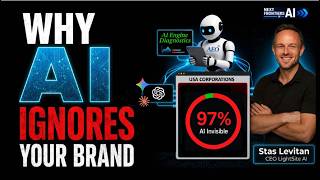
Of the 6 million corporations in the United States, more than 5.5 million are completely invisible to B2B buyers’ questions unless explicitly named by the user. That’s right—current data reveals that 95% to 97% of businesses are entirely left out of AI-mediated buyer journeys unless explicitly mentioned, which are now relied upon by over 6 in 10 buyers. Are you one of them? Why is AI ignoring your brand? 📌 Episode Overview The B2B buying journey has officially crossed the tipping point. Every single day, AI engines answer roughly 120,000 B2B buyer questions per product category—yet only a tiny fraction of those conversations ever result in a click-through to a vendor website. Control has fundamentally shifted from your owned marketing channels to AI-mediated dialogues happening entirely on the buyer's terms. In this episode, Scott Hebner (Principal Analyst & CMO Advisor at theCUBE Research) sits down with Stas Levitan (CEO of LightSite AI) to move past high-level metrics and dive into AEO Diagnostics—the critical technical and narrative discipline of discovering why AI engines reason about your brand the way they do. If your company is struggling to surface in ChatGPT, Perplexity, Claude, or Gemini, this deep dive reveals the hidden technical barriers, narrative gaps, and validation flaws keeping you invisible. 📊 The Hidden Tech Bottlenecks (By the Numbers) According to groundbreaking research highlighted by Stas Levitan from [EN] 32. AEO Diagnostics_ How to Create an AI Discovery Advantage.docx, the vast majority of B2B enterprises are failing the technical criteria required by modern Large Language Models (LLMs): 🔑 Key Takeaways: What You Will Learn The AEO Influence Chain: Why winning the AI discovery race requires a balance across four distinct layers: AI Understanding, Contextual Relevance, Citability Mechanics, and Trust Validation. Why Traditional SEO is Failing: SEO focuses on surface-level keyword mechanics and backlinks; AEO requires shaping an autonomous entity that can logically reason about your brand. The Compounding AEO Advantage: Unlike traditional search, where laggards can easily buy their way back to the top, AI search models continuously reinforce established patterns of citation and trust—making an early advantage nearly impossible to catch up to. Structured vs. Unstructured Data: Clear evidence showing why LLM bots overwhelmingly prefer schema endpoints and conversational Q&A-formatted content over standard raw text and heavy PDF assets. Deploying AI "Skills" on Your Domain: How giving LLMs a structured menu of actions transforms a random crawler into an efficient tool-user on your website. 🕒 Interactive Chapters & Timestamps 00:00 - The Invisible Brand Dilemma: The Tipping Point of AI-Mediated Buying Journeys 03:15 - Why Unknown Startups are Stealing LLM Traffic from Market Leaders 06:45 - Technical Reality Check: Why 90% of Websites are Unprepared for AI Crawlers 10:50 - The Commodity Trap: Why Tracking Mentions is Not an AEO Strategy 14:10 - Giving AI Bots "Skills": Transforming Random Crawling into Targeted Discovery 17:25 - The Content Format LLMs Prefer: Why Q&A and Structured Endpoints Win 21:40 - Breaking Down the AEO Influence Chain (Discovery vs. Trust Validation) 25:15 - Case Study: Analyzing the Autonomous AI Database Market Performance Gaps 28:10 - Root Cause Analysis: How to Diagnose Gaps Across Both On-Domain and Off-Domain Channels 31:45 - The Next Leap Forward for CMOs & B2B Growth Leaders ❓ Questions Answered in This Episode: Why are unknown startups stealing AI traffic from established brands? How do you know if your IT or security team is accidentally blocking ChatGPT and Claude? Why do LLM bots prefer Q&A formatted content over traditional website copy and PDFs? What is the "crawling budget," and why does AI only extract 20–25 KB of data per fetch? How can giving AI crawlers specific "skills" stop them from randomly indexing your site? What is the AEO Influence Chain, and how does it impact the B2B buying journey?

May 2026

42:00
theaters 9
As AI accelerates coding, a lack of team coordination is causing code duplication to spike 4x, creating a costly new crisis for enterprise leaders. Is your engineering team merely AI-active, or are they actually AI-productive? While individual coding tools and autonomous agents accelerate code creation, faster typing does not automatically translate into faster business outcomes. Today, every major AI provider is racing to make individual developers faster; nobody has built the organizational layer to compound those gains across the team. Hear why that’s the most important infrastructure decision an engineering leader will make in 2026 — and why the gap between teams that build it and those that don’t will widen faster than in any prior technology shift. In this episode of The Next Frontiers of AI, host Scott Hebner sits down with Wells Burke, co-founder and CEO of CodeVine, to map the architecture of the Compounding Gap and walk through CodeVine’s three-pillar Agentic Flow Platform — Capture, Correlate, Compound — the system of record the AI industry forgot to build, which is key to fixing the costly chaos of AI coding. 🎙️ Topics Covered: Why individual developer productivity is a value trap without organizational capture. Why rapid code generation is creating systemic organizational bottlenecks. The three-layer ROI model: activity, velocity, and business metrics The Grafting Engine and how patterns become Enterprise Skills What engineering leaders should report to the CFO on AI ROI in 30 days, not 30 months The window for building the organizational layer — why 2026 is the inflection point If you are a CTO, CIO, or engineering leader trying to figure out the true ROI of your generative AI coding tools, this deep dive is for you. #AIEngineering #AgenticAI #AICoding #DeveloperProductivity #SoftwareDevelopment #EnterpriseAI #AIGovernance #AITransformation #NextFrontiersOfAI #CodeVine #CTO #EngineeringManagement #CFO#SoftwareDevelopment #EnterpriseAI #AIGovernance #AITransformation #NextFrontiersOfAI #CodeVine #CTO #EngineeringManagement #CFO 🤖 Questions Answered in This Episode: Why is individual developer productivity considered a value trap without organizational capture? What are the specific components of the three-layer AI ROI model (activity, velocity, and business metrics)? How does CodeVine's Grafting Engine turn isolated developer breakthroughs into reusable Enterprise Skills? What should engineering leaders report to the CFO to prove real AI ROI in 30 days, not 30 months? Why is 2026 the critical infrastructure inflection point for enterprise software engineering organizations? 📝 Episode Overview: Every major AI provider is racing to make individual developers faster. However, they are solving the right problem for the wrong unit of analysis—leaving the crucial organizational layer unbuilt. While 84% of developers already use AI tools daily, most enterprises stall because individual breakthroughs remain trapped on individual laptops. When a frontier developer leaves, their custom prompts, workflow methodologies, and hard-won expertise walk out the door with them. This discussion outlines why traditional documentation frameworks (such as manual wikis or Confluence pages) inherently fail to keep pace with AI-native workflows . Instead, it highlights CodeVine's three-pillar Agentic Flow Platform—Capture, Correlate, Compound—to show how organizations can passively transform human-AI interactions into institutional intelligence at scale. 🌿 Key Takeaways: The Measurement Shift: Moving your organization's success metrics away from isolated metrics (like story points or lines of code) toward collective capability velocity. From Receipts to Returns: Transitioning past simple "Layer 01" activity tracking (tokens consumed and active licenses) into tracking true business impact like cost-per-feature and time-to-market. Passive Knowledge Grafting: How automated, invisible capture structures successful prompt architectures and context windows into version-controlled engineering assets. Autonomy with Leverage: Why providing an organizational layer gives developers immense leverage, transforming senior engineers into widespread force multipliers without restricting their workflows. 💎 The Conclusion: AI coding tools alone will not deliver enterprise transformation. The most important infrastructure decision an engineering leader will make in 2026 is to build the organizational layer that compounds what those individual tools produce. As Wells Burke states: "You can't compound what you haven't correlated. You can't correlate what you haven't captured." In an era when software creation is moving at an unprecedented agentic pace, the true differentiator shifts from who has the fastest individual developer to who builds the strongest collective engineering muscle memory.
35:57
theaters 8
Is your AI strategy stuck in the "Chatbot Era"? Discover why 60% of enterprises are moving beyond conversational AI to advanced agentic AI architectures to build production-grade digital labor, where AI agents not only automate tasks, but also know and contextualize to help humans make better judgments. In this episode of Next Frontiers of AI, host Scott Hebner is joined by Roland Boulos, VP of Solution Consulting and GTM Strategy at UnifyApps, to explore the profound shift from chatbots to autonomous Agentic AI. Roland explains why chatbots are effectively "dead" as an enterprise solution and details the new generation of agents that must know, reason, remember, contextualize, and self-optimize for ROI. As organizations re-architect for operational intelligence, they explore the critical requirements for moving AI beyond experimentation. Stop asking if AI can generate answers—it's time to ask if it can be an accountable, context-aware digital worker that delivers measurable business transformation. Key Discussion Points:  The Architecture of Agency: Why LLMs alone aren't enough and the critical role of Knowledge & Context Graphs.  Persistent Memory: Building agents that "remember" context to deliver continuous value.  AI FinOps & Economic Discipline: How to measure the business value and ROI of autonomous digital labor.  Advanced Agent Experience: Unifying context, economic discipline, and accountable execution. Next Step: To bridge the gap, now that you understand the Next Gen of AI Agents, you need to understand Digital Labor Transformation – A Guide for Leaders: https://thecuberesearch.com/digital-labor-transformation/ Learn more about UnifyApps: https://www.unifyapps.com Download the latest AI Reports: https://thecuberesearch.com/analysts/scott-hebner Subscribe for more analysis: https://aibizflywheel.substack.com Subscribe for more analysis: https://aibizflywheel.substack.com Read the full 2,000-word Research Brief dropping here next week: https://thecuberesearch.com/analysts/scott-hebner/ #AgenticAI #EnterpriseAI #DigitalWorkers #UnifyApps #AIStrategy #GenerativeAI #AIOperatingSystem #SupplyChainAI #AIGovernance #LLM Grounding #AIFactory #TechTransformation Q&A Block: Q: What is Agentic AI and why is it replacing enterprise chatbots? A: Roland Boulos explains that the "Chatbot Era" is over because simple conversational AI is no longer enough. Agentic AI is the next frontier: autonomous systems capable of reasoning, memory, and self-optimization. Instead of merely answering questions, these agents are production-grade digital laborers designed to perform accountable, context- aware knowledge work that delivers measurable ROI. Q: Why are Large Language Models (LLMs) alone insufficient for scalable Agentic AI? A: In this episode, they break down why LLMs are just the "probabilistic brain"—they need a "factual anchor." A scalable enterprise agency requires a unified architecture that includes knowledge and context graphs. These graphs provide the deterministic structure and high-fidelity, interconnected map of collective intelligence that agents need to function reliably without hallucination. Q: How does Persistent Memory make AI agents smarter over time? A: Roland describes persistent memory as transforming AI from "forgetful assistants" into context-aware digital workers. By implementing an architecture that preserves knowledge Exterior to the model, agents can retain facts, events, and decisions across sessions. This allows them to maintain context continuity, learn from past interactions, and continuously improve their operational precision. Q: What is AI FinOps, and why is it critical for autonomous workflows? A: AI FinOps (Financial Operations) is the practice of applying economic discipline to AI consumption. Boulos emphasizes that as AI moves from experimentation to execution, organizations must be able to measure the business value and ROI of autonomous workflows. AI FinOps provides real-time cost visibility and predictive insights, turning AI spend from a potential surprise into a controlled lever for growth. Q: How do Knowledge and Context Graphs enable operational intelligence? A: Knowledge graphs serve as the "intelligence substrate." They capture entities, relationships, rules, and business logic, turning probabilistic text generators into context-aware decision engines. This enables forms of reasoning (deductive, inductive, abductive) that are external to the model, allowing agents to trace every decision back to verifiable rules and align perfectly with enterprise policies.

April 2026

30:18
theaters 8
Why is 85% of enterprise AI stalling? The problem isn't the model—it's an execution crisis. Just as the "Browser Wars" of 30 years ago were won not by the browser itself, but by how companies built around that gateway to the internet, the AI era will be defined by an enterprise's ability to build a high-velocity execution architecture around LLMs. In this episode of The Next Frontiers of AI, Scott Hebner and Nitesh Bansal (CEO of R Systems) reveal that the biggest barrier to success is no longer model capability or trust & governance, but the failure to achieve Engineering Velocity. In this Breaking Analysis, we unpack:  The 15% Scaler Gap: Why 57% of organizations are stuck in "Pilot Purgatory" while only a 15% have emerged as true "Scalers" achieving autonomy in governed workflows.  The Hardcoding security, guardrails, and compliance into the base layer. 2. Brownfield Connectors: Seamlessly linking AI to legacy upstream and downstream systems. 3. 3. Eval-First Engineering: Prioritizing prompt engineering and rigorous testing before deployment. 4. FinOps & Context: Driving token frugality and cost-efficiency to ensure sustainable ROI. 5. 5. Domain SLMs: Leveraging Small Language Models (SLMs) to embed proprietary organizational context.  Case Study: 16 Months to 9 Weeks: How payment orchestrator Spreedly collapsed a Beyond the Model Wars: Why enterprise differentiation lies in proprietary architectures rather than foundational models like OpenAI, which are rapidly becoming gateways.  ⌛ Chapters:  00:00 — Why is 85% of Enterprise AI Stalling? (The high-stakes gap between pilots and ROI)  03:04 — The B2C vs. B2B Disconnect: Why consumer AI distribution is creating "Tool Fatigue"  06:50 — What is Engineering Velocity? (Defining the new determinant for AI success)  10:35 — The Browser Wars Analogy: Why picking a model is just picking a gateway  14:45 — The  19:20 — The Spreedly Case Study: How to collapse a weeks  24:00 — Building the AI Studio: How reusable assets and evals drive 2x velocity  28:15 — The 2026 AI Roadmap: Moving from "Explorer" to task-level autonomy �� Next Step: Bridge the Gap Now that you understand the Velocity Trap, you need to understand How to Build Trusted Mutli-agent Systems. Watch here: https://youtu.be/ety7TLaiDU8?si=6cl4x2SsMyvkLKResearch Brief dropping here next week: https://thecuberesearch.com/analysts/scott-hebner/ Q&A Block: Q: Why are AI projects failing to deliver ROI? A: Most initiatives lack Engineering Velocity—the ability to iterate quickly through the "brownfield" complexities of an enterprise landscape. Q: How can enterprises accelerate AI deployment? A: By focusing on the "Execution Architecture" rather than model selection. This includes building an "eval-first" mindset and creating reusable connectors and prompt harnesses. Q: What is the "15% Scaler Gap"? A: Only 15% of enterprises have moved beyond pilots to achieve task- level autonomy in well-governed workflows. Quick Diagnostic: Q: Why is enterprise AI ROI stalling? A: Because 85% of organizations lack Engineering Velocity—the ability to move through brownfield integration complexities quickly. Q: How did Spreedly achieve 2x velocity? A: By utilizing an AI-first execution architecture that collapsed a Explore R Systems: https://www.rsystems.com �� Explore the EXIQO AI Studio: https://exiqo.ai �� Download the latest AI Reports: https://thecuberesearch.com/analysts/scott-hebner �� Subscribe for more analysis: https://aibizflywheel.substack.com 00:00 - Intro 00:04 - Navigating the Complex Landscape of Enterprise AI: Challenges, Insights, and Historical Parallels 03:57 - Accelerating Success: A Journey Through Engineering and Innovation 06:40 - Advancing AI: The Intersection of Trust, Strategy, and Technological Evolution 10:16 - Navigating the AI Ambition-Execution Gap: Understanding Velocity Traps 16:06 - The Five-Layered Cake for AI Implementation 19:16 - The Spreedly Success Story 22:24 - Strategic Insights and Future Perspectives on AI

February 2026

January 2026

December 2025

November 2025

October 2025

September 2025

August 2025

July 2025

June 2025

May 2025

April 2025

March 2025

programImage
About the Program
AI is still in its infancy, but innovation cycles and the pursuit of high-value ROI are advancing at warp speed. The ability to keep up will determine who leads, who lags, and who fails.

Join theCUBE Research principal analyst Scott Hebner and industry pioneers and experts to explore the latest advancements shaping the future of AI and how to prepare today.